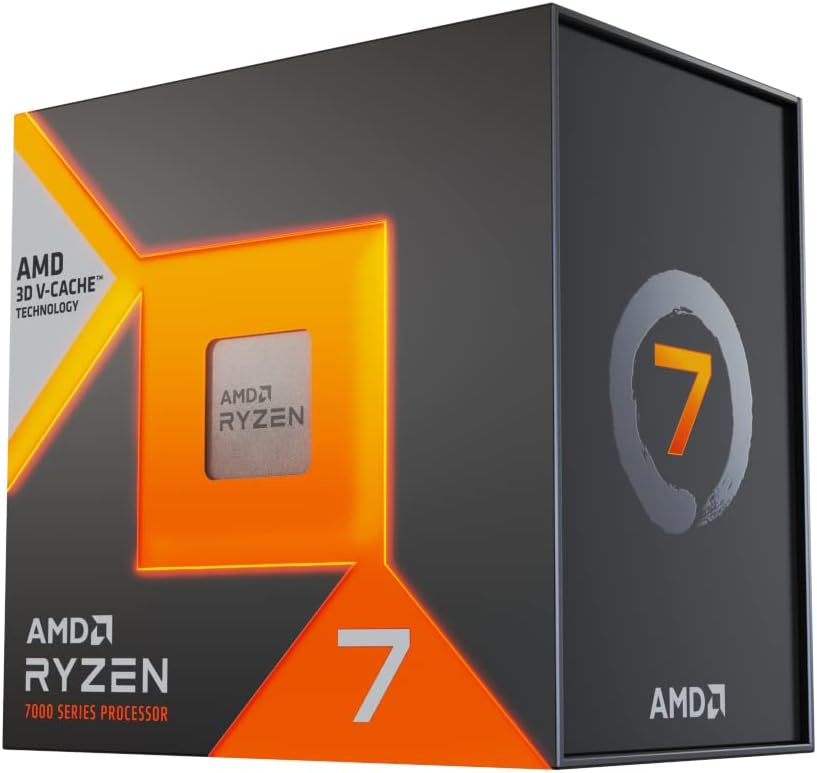
AMD Ryzen 7 7800X3D
Bottom Line
The default recommendation for a gaming-first build. Unless you have a specific reason to need more than 8 cores or the dual-CCD 9950X3D's newer Zen 5 cores, this is the chip: cheaper than the 9800X3D below, and the single-CCD design means there's nothing to misconfigure.
Pros & Cons
✅ Pros
- Single CCD design: no scheduler complexity, every game gets full V-Cache benefit automatically
- Best-in-class gaming performance per dollar on the current AM5 platform
- Lower power draw than a same-tier non-X3D chip, easier to cool quietly
- AM5 socket has a real upgrade runway (Zen 5, Zen 6 committed by AMD)
❌ Cons
- 8 cores can bottleneck heavy content creation or virtualization workloads
- Requires a full AM5 platform: new board and DDR5, real cost if coming from AM4
- Clocked lower than non-X3D Ryzen 7 chips, so it trails slightly in pure single-thread work
Best For
- A dedicated gaming build where gaming FPS is the priority, full stop
- Silent/SFF builds: lower power draw than the flagship X3D chips
- Anyone building fresh on AM5 who isn't also doing heavy multithreaded work
Performance & Real-World Usage
Specifications
Released in 2023 (Zen 4), the 7800X3D is the chip most gaming recommendations on this site point to. It’s the case study for our build budget guide’s argument that games want a strong GPU and a merely adequate CPU, not the reverse.
Why single-CCD beats dual-CCD for pure gaming
AMD’s dual-CCD X3D chips (7950X3D, 9950X3D below) put the extra V-Cache on only one of the two compute dies, which means the operating system’s scheduler has to correctly route a game’s threads to the cache-heavy CCD and everything else to the plain one. When that scheduling works, a dual-CCD chip can match or beat this one. When it doesn’t (and it doesn’t always, especially right after a Windows update), a game can end up running on the wrong CCD and losing most of the V-Cache advantage entirely. The 7800X3D has no such failure mode: there’s only one CCD, so there’s nothing to misroute.
🛒 Buy the Gear in This Guide
As an Amazon Associate we earn from qualifying purchases, at no extra cost to you. Prices and availability are shown on Amazon's own product page, not here, since they change constantly.
☕ Coffee Corner
Compiling, deploying, or waiting on a render? Here's what to brew while you wait.


🏠 Smart Home Picks
Same hobbyist care applied to your network and your front door.