Where to Spend the Money on a PC Build
Updated 2026-09-24
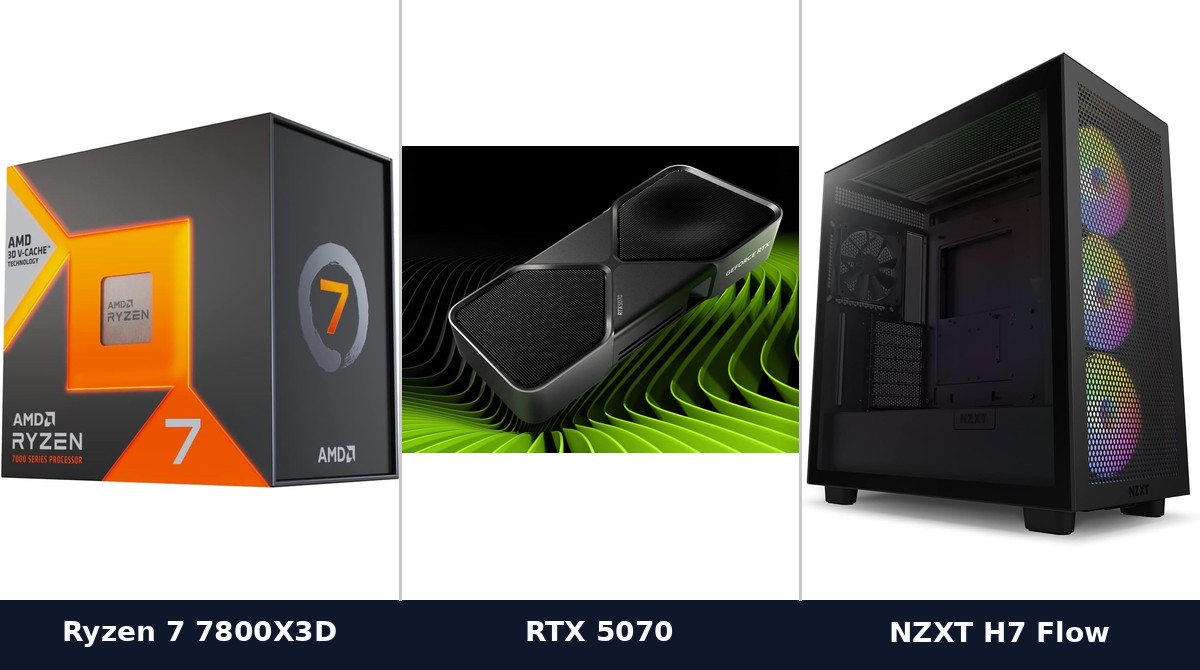
Specific parts lists go stale in weeks. Prices move, a new tier launches, the part everyone recommended gets discontinued, and the guide that named it is now confidently wrong. What doesn’t change is how the money should be split, and that’s worth more than a shopping list you’d need to re-check anyway.
So this is about proportions, not part numbers.
The split that works
For a machine mainly used for gaming, the graphics card should take the largest single share: roughly half the budget once you exclude the monitor. Everything else exists to keep the GPU fed.
That ratio holds surprisingly well from entry level upward, and the mistakes people make are almost always a departure from it. A build with a top-tier processor and a mid-tier graphics card will be beaten in games by the reverse split at the same total cost, because games ask the GPU to do the expensive part.
For work that isn’t gaming, invert your instincts. Video editing, compiling, running VMs and anything with “render” in the name care about cores and memory far more than about graphics. A workstation and a gaming PC at the same price should not contain the same parts.
What each tier actually buys you
Entry level. The goal is a machine that plays current games at 1080p without stuttering. This is achievable and has been for years. The trap is buying a weak graphics card to afford a processor you won’t use. At this tier, a modest CPU paired with the best GPU you can afford beats a balanced split.
Mid range. This is where 1440p at a high refresh rate becomes realistic, and it’s the tier with the best return per dollar. The jump from entry to mid is the largest single improvement you can buy; the jump from mid to high is noticeably smaller and costs considerably more.
High end. 4K, high refresh rates, and headroom for things that aren’t games. Be honest about whether you’ll see it. If the monitor is 1080p, most of this money does nothing at all: you’ll hit a CPU or display limit long before the graphics card is working hard.
That last point is the most common expensive mistake: a graphics card chosen for a monitor that can’t show what it produces.
Where people overspend
The processor, almost always. The gap between a mid-tier chip and a flagship is small in games and large on the invoice. Games lean on a few cores; they do not scale to sixteen. Buy the flagship if you compile or render, not because it benchmarks well in a chart you saw.
Memory capacity over memory speed. Once you’re at a sensible capacity for what you do, more sticks rarely help, and exotic high-frequency kits cost real money for differences you won’t feel outside a benchmark. Capacity first, speed second, and stop.
Motherboards. A lot of the price difference is features you will never use: extra M.2 slots, heavier VRM cooling for overclocking you won’t attempt, networking you don’t have. Buy for the socket, the connectivity you’ll actually plug into, and a chipset that supports your chip properly.
RGB anything. No judgement, but count it as part of the case budget rather than pretending it’s a performance purchase.
Where people underspend
The power supply, consistently. It’s the one component whose failure can take others with it, it’s the least interesting thing to spend on, and it’s therefore where people economize. Buy a unit from a reputable manufacturer with a long warranty and enough headroom that it isn’t running at its limit. A power supply working flat out is a loud power supply, and a cheap one failing badly is an expensive afternoon.
Storage type, not size. An NVMe drive versus a SATA one is a difference you notice every single day: boot, launch, load, copy. A slightly larger slow drive is a worse buy than a slightly smaller fast one. You can add capacity later; you can’t make a slow disk fast.
Cooling and case airflow. Thermal throttling is invisible: nothing fails, nothing warns you, the machine is simply slower than the one you paid for. This is the cheapest performance on the list, and it’s the one most often skipped.
Prebuilt or self-built
Building it yourself saves money and you learn the machine, which matters later when something goes wrong at 11pm. That’s the real argument, and it’s a good one.
The honest counter-arguments: a prebuilt arrives working, carries a single warranty covering everything, and usually includes a Windows license you’d otherwise buy separately. If a part fails in a self-built machine, working out which one is your job, and every manufacturer will suggest the fault lies with someone else’s component.
Build it yourself if the process appeals or the budget is tight. Buy prebuilt if you want a working computer with one number to call. Neither is the beginner mistake it’s sometimes made out to be.
Before you buy anything
Decide the monitor first. Resolution and refresh rate set the entire budget, because they determine how much graphics card is useful. Choosing parts before you know what they’re driving is how people end up with a machine that’s expensive in the wrong places.
Then work backwards: GPU sized to the display, CPU sized to keep it fed, memory and storage sensible rather than impressive, and a power supply with room to breathe.
☕ Coffee Corner
Compiling, deploying, or waiting on a render? Here's what to brew while you wait.


🏠 Smart Home Picks
Same hobbyist care applied to your network and your front door.