Coffee Grind Size and Water Temperature: A Reference Guide
Updated 2026-08-21
Grind size and water temperature are the two variables that decide whether the same bag of beans tastes completely different brewed two ways. Both control the same underlying thing: extraction rate, how fast water pulls flavor compounds out of the grounds. Get the rate wrong for the contact time your method gives it, and the cup tastes wrong in a predictable, fixable direction.
Grind size by method
| Method | Grind | Contact time | Why |
|---|---|---|---|
| Cold brew | Extra coarse | 12-24 hours | Long contact time means even coarse grounds fully extract; fine grounds would badly over-extract and turn muddy |
| French press | Coarse | 4 minutes | Full immersion with no filter to slow flow, so fine grounds slip through the mesh and turn the cup gritty |
| Drip machine | Medium | 5-6 minutes | Middle-of-the-road contact time, middle-of-the-road grind |
| Pour-over | Medium-fine | 2:30-3:30 | Shorter contact time than drip needs a slightly finer grind to extract enough in the window |
| Moka pot | Fine (not espresso-fine) | 4-5 minutes under pressure | Finer than drip, coarser than espresso; too fine chokes the pot’s low-pressure system |
| Espresso | Extra fine | 25-30 seconds | Contact time is measured in seconds, so extraction has to happen fast, and this only works because pressure forces water through instantly |
The pattern: shorter contact time needs a finer grind (more surface area, faster extraction); longer contact time needs a coarser grind (less surface area, so it doesn’t over-extract before time’s up).
Water temperature by method
195-205°F (90-96°C) covers nearly everything: drip, pour-over, French press, moka pot. Straight off a rolling boil is slightly too hot for delicate light roasts; letting boiled water rest 30-60 seconds gets you into range without a thermometer.
Espresso runs about the same range (195-205°F) but the pressure, not the temperature, is what changes the extraction: an espresso machine’s boiler holds this automatically.
Cold brew uses room-temp or refrigerator-cold water: no heat at all. That’s the entire mechanism that makes it taste different from iced hot coffee; see our cold brew extraction guide.
Burr grinder vs. blade grinder: this isn’t a minor upgrade
A blade grinder chops beans into random sizes: some dust, some chunks, in the same batch. Every method above assumes a consistent grind size; a blade grinder can’t produce one, so part of every batch is always over- or under-extracted no matter how well you dial in ratio and temperature. A burr grinder crushes beans between two fixed surfaces at a set gap, producing a genuinely consistent particle size. If you only upgrade one piece of gear after reading this, make it the grinder: it’s the one variable that, done wrong, silently sabotages every other variable you get right.
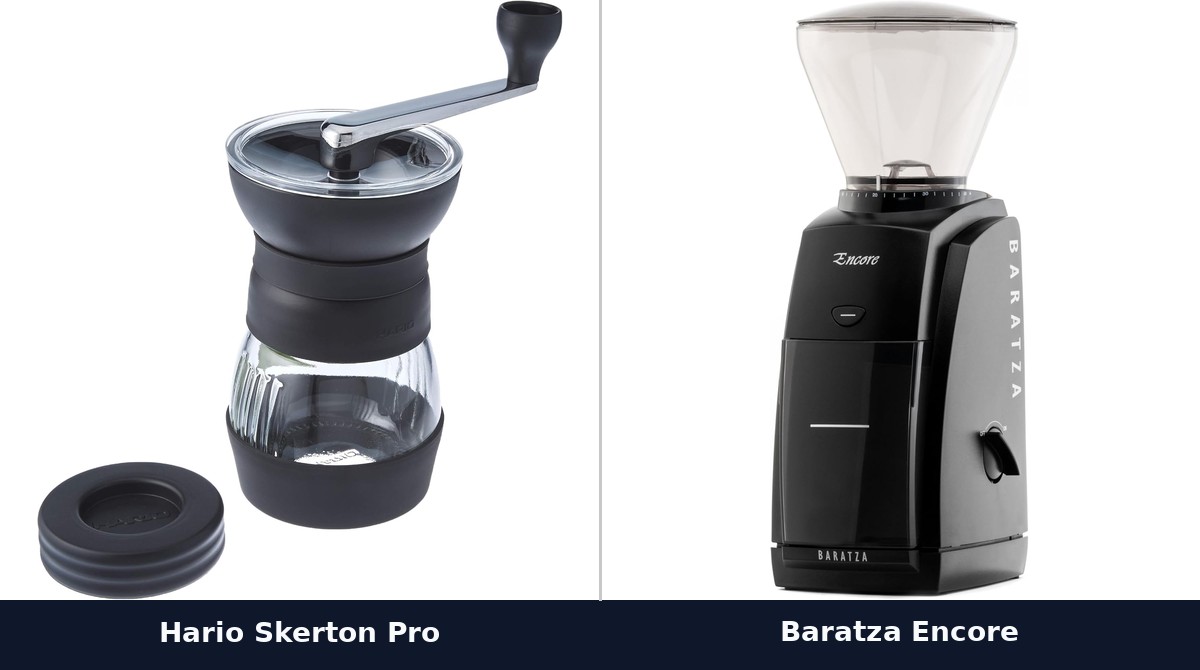
Budget / manual ($54.71): Hario “Skerton Pro” Ceramic Coffee Mill, hand-crank, ceramic conical burrs, holds enough grounds for up to 8 cups. No power needed, travels well, genuinely consistent grind for the price of one bag of decent beans.

Mid-range / electric ($149.95): Baratza Encore Conical Burr Grinder, 40 grind settings covering everything from espresso to French press, a front-mounted pulse button, and a 1-year warranty. The grinder most enthusiast sites default to recommending for a reason: it’s consistent across the entire range in this table, not just one method.

Adjusting a bad cup, fast
Same troubleshooting logic works for every method above:
- Sour, weak, thin → under-extracted → grind finer, raise water temperature, or extend contact time
- Bitter, harsh, dry aftertaste → over-extracted → grind coarser, lower water temperature, or shorten contact time
Change one variable at a time. Changing grind and temperature together makes it impossible to tell which one actually fixed the cup, and you’ll be back here guessing again tomorrow.
🛒 Buy the Gear in This Guide
Hario "Skerton Pro" Ceramic Coffee MillView on Amazon →Baratza Encore Conical Burr GrinderView on Amazon →As an Amazon Associate we earn from qualifying purchases, at no extra cost to you. Prices and availability are shown on Amazon's own product page, not here, since they change constantly.
🏠 Smart Home Picks
Same hobbyist care applied to your network and your front door.